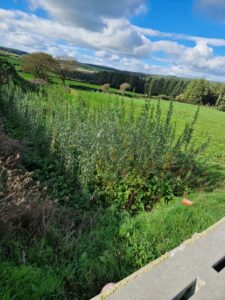
CASE STUDY: Protecting the River Licky and Freshwater Pearl Mussel Habitat
A farm-level case study from Carrigeen, Ring, Dungarvan, Co. Waterford
| CASE STUDY AT A GLANCE
A sustained ASSAP advisory relationship identified farm-to-water risk pathways and supported a targeted €14,006 Farming for Water EIP package. The integrated approach combines source control, clean-water separation, runoff interception, a willow filter bed, improved slurry-storage resilience and precision nutrient planning. Together, these measures are designed to reduce nutrient, sediment and dirty-water losses to the Licky_010 waterbody and help protect the sensitive freshwater habitat on which Freshwater Pearl Mussel depends. |
Farmer: M & A Dower Limited EIP00212
Advisor: Marie Kearney, Teagasc ASSAP
Area for Action Licky Area for Restoration 2nd Cycle AFA0105 : Licky_010, Waterford – Protecting Good Ecological Status and the Fresh water Pearl Mussel
Case study date: August 2026
Executive Summary
The Michael Dower farm demonstrates how catchment science, trusted advisory engagement and targeted financial support can be combined to convert identified water-quality risks into practical farm action. The farm holding is located at Carrigeen, Ring, Dungarvan, within the Licky_010 catchment. The farm has been engaged through the Agricultural Sustainability Support and Advisory Programme (ASSAP), with the initial assessment undertaken in 2020 and follow-up advice continuing through 2026.
The advisory process identified potential loss pathways associated with silage-pit and slab runoff, dirty yards, yard-drain connections, farm roadways and gateways, stream drinking points, nitrogen leaching and soil-fertility management. The agreed response is an integrated treatment train that prioritises control at source, safe storage, interception of runoff, treatment and nutrient uptake, followed by verification and continued monitoring.
In October 2024, a €14,006 Farming for Water EIP package was approved. The measures include a willow filter bed, a bespoke measure, a nitrogen surplus plan and annual elements, earthen bunds, a rainwater management plan, contractor mobilisation and farmer training. Separate investment in covered slurry storage in 2024 and 2025 increased recorded storage capacity to 2,073.3 m³, providing a calculated surplus of 192.9 m³ over the recorded requirement. This additional headroom supports better timing of slurry applications and reduces pressure to spread in unsuitable weather or soil conditions.
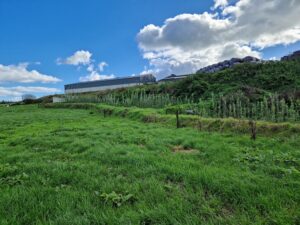
The willow filter bed is working a treat with the willow plants doing really well -0 an indication that they are soaking up nutrients from farm run-off
Encouragingly, water quality in the headwaters of the Licky waterbody is currently reaching its target of Good Ecological Status under the Water Framework Directive, demonstrating the value of coordinated action at farm and catchment level for water quality – a main focus is to reduce sediment and nutrients into the river.
The case study illustrates the value of applying the “right measure in the right place” principle. While the supplied records do not verify a biological response in Freshwater Pearl Mussel, the measures directly address pressures that can damage sensitive river habitat, particularly rapid delivery of sediment, nutrients and contaminated runoff. Completion, maintenance and post-rainfall inspection remain essential to ensure that approved works deliver their intended water-quality benefit.
Key Facts
| Case study element | Recorded information |
| Farm | M & A Dower Limited, Carrigeen, Ring, Dungarvan, Co. Waterford |
| Waterbody | Licky_010 |
| Managed grassland | 112.81 ha |
| Livestock | 191 dairy cows |
| Grazing land | 92.90 ha |
| Recorded stocking rate | 186.8 kg N/ha |
| Recorded slurry-storage capacity | 2,073.3 m³ |
| Recorded storage requirement | 1,880.4 m³ |
| Recorded storage surplus | 192.9 m³ |
| Farming for Water EIP approval | €14,006, issued 30 October 2024 |
1. Catchment and Conservation Context
Freshwater Pearl Mussel is dependent on clean, well-oxygenated river habitat with stable riverbeds and low levels of fine sediment and nutrient enrichment. At farm level, the most relevant protective actions are those that prevent contaminated water, soil and nutrients from being rapidly transferred from yards and fields into drains, streams and the wider river network.
The measures selected for this farm are therefore presented as a habitat-protection package for the River Licky. Their purpose is to break or slow farm-to-water pathways, improve nutrient-use efficiency and strengthen management resilience. The case study does not claim that the farm is the sole influence on the waterbody, or that the approved works alone can demonstrate recovery of the mussel population. Rather, it shows how targeted actions on an individual farm can contribute to the wider catchment effort required to protect a highly sensitive aquatic species.
The Licky River in County Waterford supports one of Ireland’s critically endangered freshwater pearl mussel populations. Freshwater pearl mussels can live for over 150 years and are among the most sensitive indicators of river health. Their decline is often a warning sign of declining water quality, excessive sediment loss and nutrient enrichment within the catchment.
Historical assessments identified the Licky pearl mussel population as being under threat due to habitat deterioration and siltation, with very few juvenile mussels present to replace the ageing adult population.
Protecting and restoring water quality in the Licky catchment is therefore essential for the survival of this iconic species and the wider river ecosystem
- The Licky river is located with within Munster Blackwater catchment; River is one of Ireland’s most important freshwater pearl mussel rivers.
- The Licky is reaching its goal of good ecological status water quality under the Water Framework Directive
- Freshwater pearl mussels can live for over 150 years, making them one of the longest-lived invertebrates on Earth.
- Fewer than 50 rivers worldwide are believed to support internationally important recruiting populations of freshwater pearl mussels, highlighting just how rare and threatened this species has become.
- Freshwater pearl mussels are often described as the “canary in the coal mine” for river health. Their survival depends on exceptionally clean, well-oxygenated rivers, so declining mussel populations are a warning sign that water quality is deteriorating.
There are 79 approved measures under the Farming for Water EIP in nine different farms in the Licky catchment – 3 Licky subbasins. This catchment approach is seen as being very significant and the implementation of all of these approved measures is now regarded as being a key factor in maintaining the good water quality status of the river.
Check out the Farming for Water EIP Information Booklet to see what measures are available
2. Farm Profile and Advisory Journey
The enterprise comprises 112.81 ha of managed grassland, including 92.90 ha of grazing land, and supports 191 dairy cows. The recorded stocking rate is 186.8 kg N/ha. Soil pH is generally favourable, but phosphorus and potassium results show a need for carefully targeted build-up on low-index fields. This creates a management challenge: improving soil fertility and farm productivity while avoiding nutrient applications in locations or conditions where losses to water are more likely.
| Date | Advisory milestone | Outcome / focus |
| 1 October 2020 | Initial farm assessment | Baseline assess
ment identified critical source areas and nutrient-loss pathways. |
| 5 January 2024 | First follow-up | Infrastructure focus and agreement to enhance slurry-storage capacity. |
| 30 October 2024 | EIP approval | €14,006 approved for targeted water-protection measures. |
| 15 January 2025 | Second follow-up | Progress reviewed; a second covered tank was recorded in the nutrient management plan. |
| 11 June 2026 | Third follow-up | Yard-drain controls and nutrient-planning implementation reviewed. |
| 20 August 2026 | Scheduled follow-up | Presentation identified this visit for confirmation of implementation, maintenance and monitoring actions. |
3. The Integrated Water-Protection Measures
The agreed package follows a treatment-train approach. No single intervention is relied upon in isolation. Instead, measures are combined so that pollution is prevented at source where possible, intercepted where necessary, treated before discharge and supported by better nutrient and farm management.
Control at source
| Protection function | Reduces the volume and contaminant load entering the drainage network. |
Store safely
| Protection function | Supports spreading at suitable times and reduces the risk of emergency or poorly timed applications. |
Intercept runoff
| Protection function | Slows runoff and reduces direct transport of soil and associated nutrients to the waterbody. |
Treat and polish
| Protection function | Provides an additional treatment stage through slowing, filtration, plant uptake and evapotranspiration. |
Improve nutrient-use efficiency
| Protection function | Targets nutrients to crop and soil need while maintaining protective buffers. |
Verify and maintain
| Protection function | Confirms that measures are installed, functioning and maintained as intended. |
4. Farming for Water EIP Investment
The following measures were recorded in the Farming for Water EIP approval schedule. Approval confirms the supported package; the presentation notes that final verification and payment remained dependent on implementation evidence.
| Approved measure | Value |
| Willow filter bed | €6,800 |
| Bespoke measure | €5,000 |
| Nitrogen surplus plan and annual elements | €1,000 |
| Earthen bunds | €600 |
| Rainwater management plan | €250 |
| Contractor mobilisation fee | €200 |
| Farmer training course | €156 |
| Total approved investment | €14,006 |
Willow filter bed: targeted treatment
Up to this, grey water ran off the
yard to the drains or over a sacrificial paddock. To reduce fine sediment inputs, the farmer applied for a willow filter bed. The approval provides for 200 m of willow filter bed at a recorded rate of €34/m. The measure is intended to receive a controlled runoff stream, slow flow, retain solids and support nutrient and water uptake through vegetation and evapotranspiration.
It must operate as part of the wider system and does not replace clean-water diversion, source control or adequate storage.
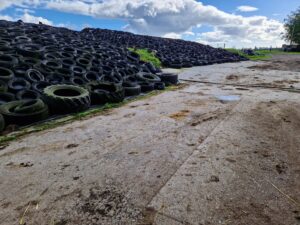
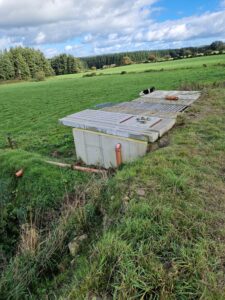
Above left: The farmyard from where the grey water was diverted and below, the settlement tank.
5. Progress and Anticipated Environmental Benefit
The clearest documented progress is in farm infrastructure, management planning, and continuity of advice. Two covered slurry tanks recorded in 2024 and 2025 increased total storage capacity. Yard-drain connections were blocked, reducing direct loss pathways. The 2026 nutrient management plan provides a plot-level basis for slurry and fertiliser allocation, while the EIP package adds runoff interception and treatment measures.
For the River Licky and Freshwater Pearl Mussel habitat, the expected benefit is a reduction in the frequency and magnitude of sediment, delivery from the farm. This is an anticipated pathway-based benefit rather than a verified ecological outcome. Demonstrating catchment or species response requires wider water-quality and ecological monitoring over time, alongside confirmation that the farm measures have been completed and continue to function correctly – get information from NPWS.
6. Verification, Maintenance and Next Priorities
- Inspect the sediment trap, earthen bunds, waterbars, willow bed, inflow and outlets after heavy rainfall.
- Check that there is no bypass, direct discharge, bund erosion or visible sediment plume.
- Maintain usable slurry-storage headroom and follow the plot-level slurry and nutrient plan.
- Review soil analysis, nutrient imports and nitrogen and phosphorus surplus annually through the NMP and AgNav processes identified in the presentation.
- Review how many additional farms have engaged with the Farming for Water EIP project in the area
- Engage with NPWS to get status update on Freshwater Pearl Mussel population
- Engage with the Forestry Service in DAFM to see what additional protection measures they are affording to the area to protect the freshwater Pearl Mussell
- Action for Inland Fisheries Ireland on EDEN – What is driving moderate fish status? What measures, if any, can be implemented in order to bring fish status to Good? Check with Fiona Kelly Inland Fisheries Ireland
7. Lessons for Wider Delivery
Advisory continuity matters: Repeated engagement from assessment through implementation helps maintain momentum, resolve practical issues and embed management change.
Measures must be integrated: Storage, drainage control, interception, treatment and nutrient planning reinforce one another; isolated measures are less robust.
Catchment science must guide investment: Mapping drainage pathways and intervention points supports the right-measure, right-place principle.
Verification is part of delivery: Approval alone is not an outcome. Installation evidence, post-rainfall checks and maintenance are needed to demonstrate that measures are operational.
Ecological claims require monitoring: Farm actions can reduce relevant pressures, but species status can only be reported where supported by appropriate ecological evidence from NPWS – need inputs on their monitoring of populations
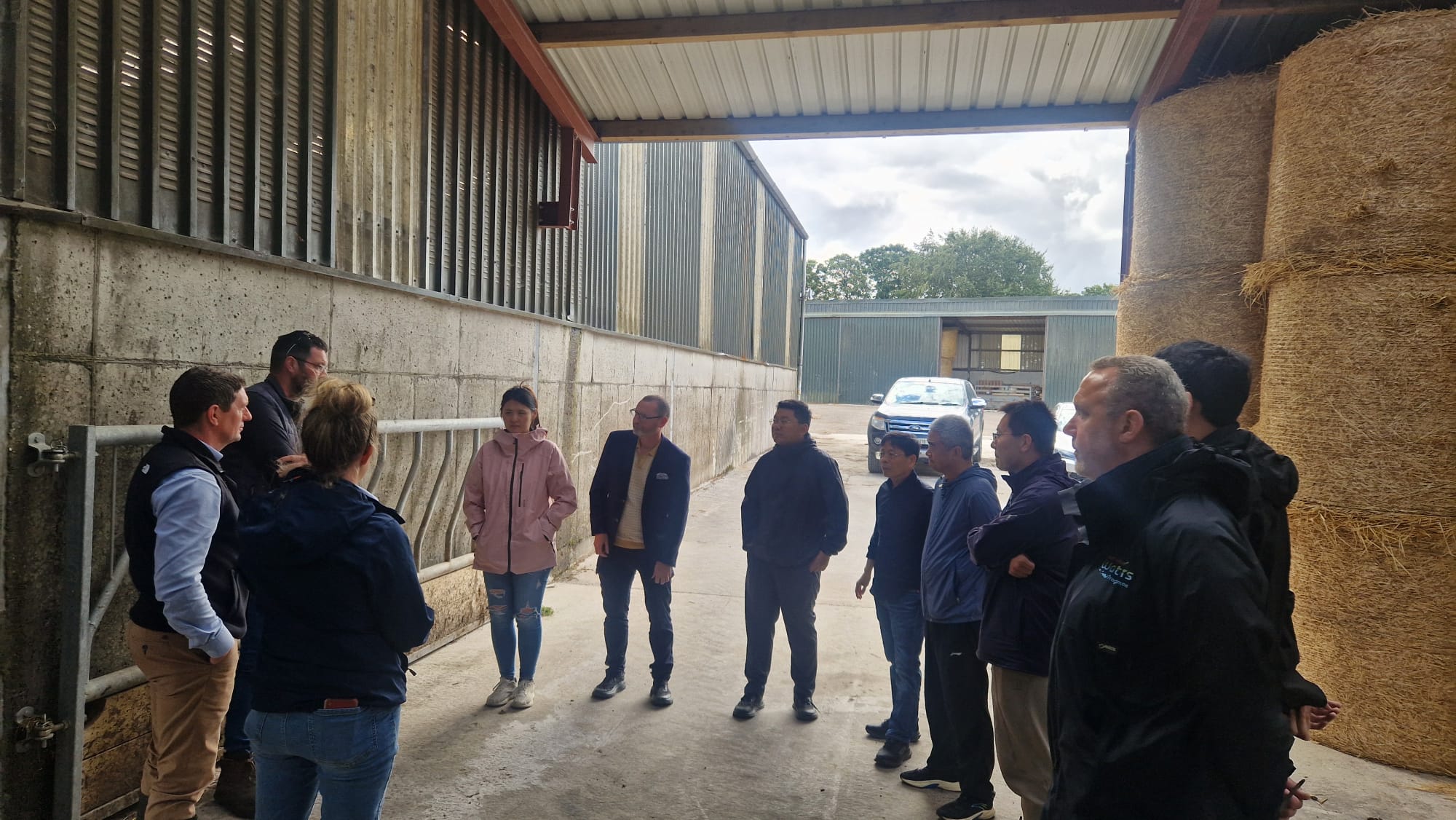
Demonstration for wider learnings On the 20th August 2026, the River Basin Management Service (Jim Croke) and the Farming for Water EIP Team (Joan Martin), at the invitation of Teagasc (Professor Owen Fenton), met with four researchers from the Chinese Academy of Agricultural Sciences in Beijing, led by Professor Hongbin Liu.The visit provided an excellent opportunity to exchange knowledge on water quality research, agricultural policy, and practical nature-based solutions to support sustainable farming and to protect water quality. Discussions included on-farm visits with Cathal Somers (ASSAP Manager), Marie Kearney (ASSAP Advisor), and participating Farming for Water EIP farmer Michael Dower, showcasing Ireland’s catchment-based approach to improving water quality through farmer-led action.
Conclusion
| The Dower farm case study shows how a positive farmer-advisor partnership can move from risk identification to targeted investment and measurable management change. By combining source control, storage resilience, runoff interception, treatment and precision nutrient planning, the Farming for Water EIP package provides a practical farm-level contribution to protecting the River Licky and the sensitive freshwater habitat required by Freshwater Pearl Mussel.
The willow bed planted as 9” slips in January 2026 has quickly developed and by October 2026 some of the willows had reached a height of 11ft. Three different varieties of willow were planted in three separate bunded beds connected by an overflow pipe. It was noticeable that the willow plants in the first bed were far more advanced than the plants in bed number 2; and those in bed 2 were more advanced than those in bed 3. This indicates that a significant portion of the nutrients released into the bed were soaked up by the plants in bed 1, while bed 2 and bed 3 soaked up proportionate residual nutrients which had still passed through bed 1. |
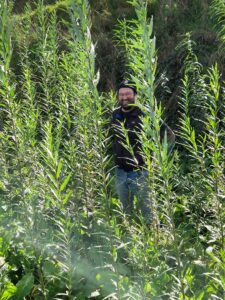
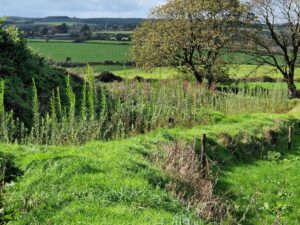
Above top: The willows in bed number 3 – the farthest bed from the where the grey water is released from the settlement tank have developed slower than the ones in bed number 1 (above) where the height of the willows is illustrated by farmer Michael Dower.
Source and limitations
Prepared from the information from Michael, ASSAP and presentation “Michael Dower Case Study” (August 2026) from Marie Kearney ASSAP Advisor. Figures, dates and measure details are reproduced from that presentation.
Figure 1 Research visit to Michael Dower’s farm on August 20th 2026
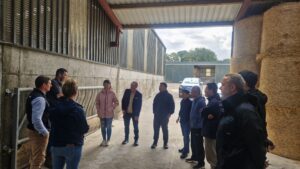
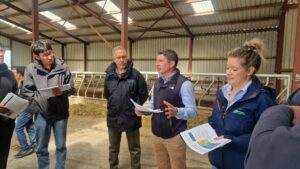
Figure 2 Farm location in the Licky_010
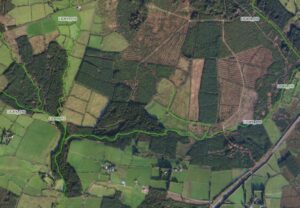
Figure 3 Settlement tank and willow filter bed on Michael’s farm.