

Cashel farmer highlights the benefits of Farming for Water EIP Measures
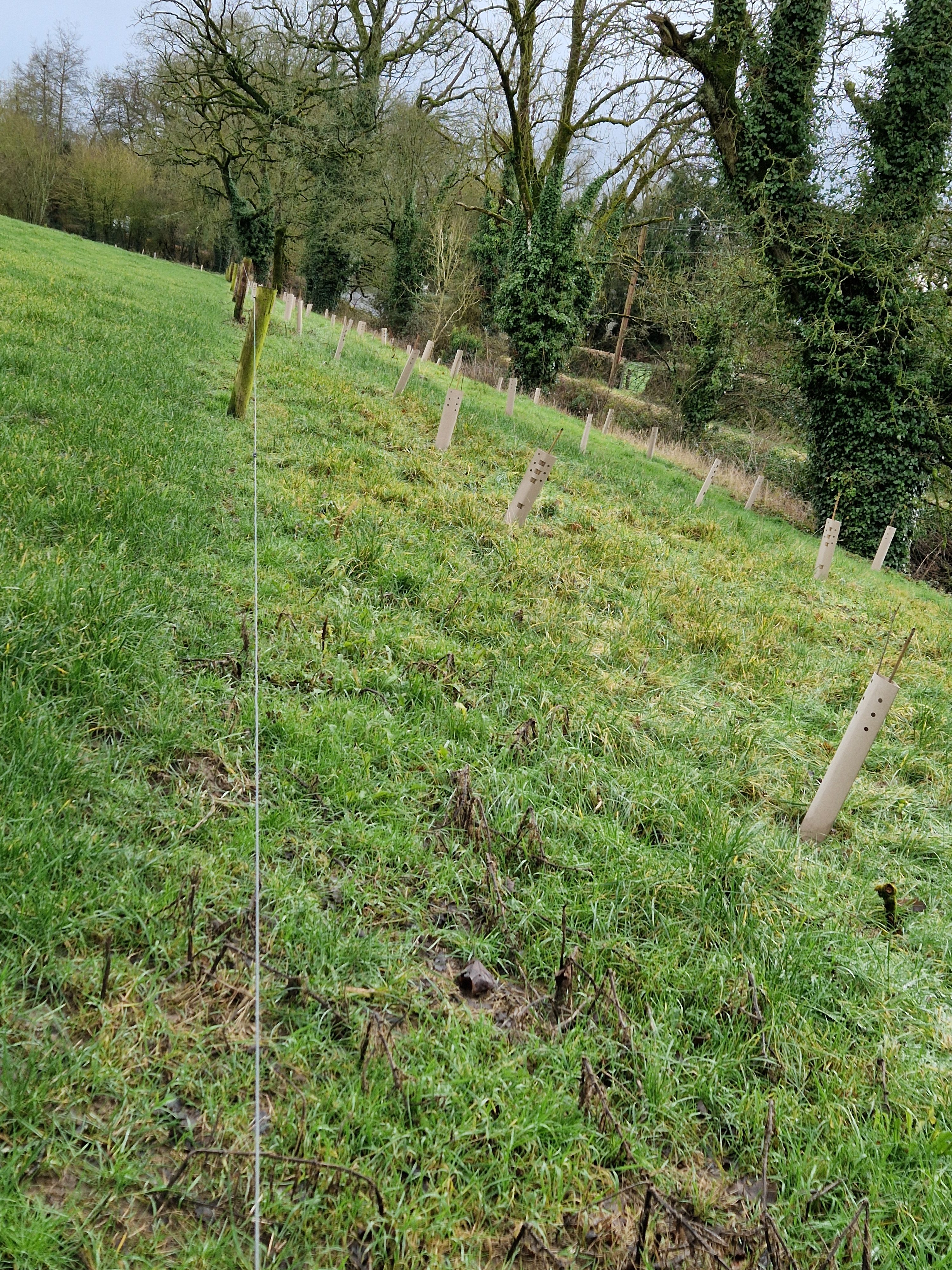
A wooded buffer along one or both banks of a river provides significant water quality benefits and is regarded as one of the key measures of the 43 included in the €50 million Farming for Water EIP.
Trees help absorb excess nutrients, such as phosphorus, and prevent sediment from reaching the river. They also increase soil infiltration rates and slow the overland flow of water. Additionally, trees stabilise the riverbank, reducing erosion, and offer a terrestrial habitat for various animal species. Trees especially if planted on southern banks also help to keep rivers cool, which is important to prevent fish stress.
It was for all these reasons that dairy farmers Brendan and Margaret Phelan decided to plant 140 trees in three separate locations on the land he farms just outside Cashel in County Tipperary.
Brendan, formerly an engineer, took lease of Beechmount Farm two years ago with his wife and he recognised straight away that there were measures he could implement under the EIP to help water quality and to prevent loss of nitrates into the local stream into the on-farm drainage network. The farm is located within the Clashawley Area for Restoration under the Local Authorities Waters Programme as part of the Water Action Plan. Catchment assessments have identified this section of the river as requiring nutrient reduction measures (both Nitrogen and phosphorous), as it is currently achieving only Moderate Ecological Status rather than the target of Good Ecological Status.
Having consulted with his Tírlán advisor and drawn up a Rainwater Management Plan for the farm, Brendan, along with the landowners, Sarah Furno and Louis Grubb; identified three specific locations where tree planting would be particularly beneficial. And, having sourced the trees at close-by Dundrum Nursery he set about the task, mixing alder with birch and oak.
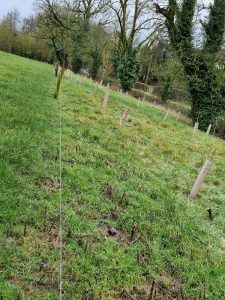
Caption: Some of the trees planted by Brendan on his farm.
“We identified three different locations on the farm where tree planting would be of benefit to water quality and we decided to do it. Everybody wants to have clean water – it benefits everyone and by taking these small steps, we are helping to play our part,” Brendan says.
Brendan also went the extra mile by utilising sustainable cardboard tree guards. These WhiptecBio Biodegradable tree guards have been developed with advice from many arboriculturists for over close to a decade and the eco-friendly protective sleeves are designed to shield young trees from external elements and promote healthy growth.
The best part is that they biodegrade after between two-four years and are therefore kind to the environment.
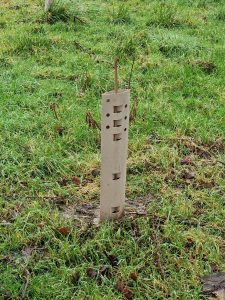
Caption: The biodegradable cardboard tree guards
Brendan and Margaret’s farm is leased from the Grubb family. Louis Grubb, a Botanist by training, has always valued nature and oversees an ongoing program of nature management on his farm. The farm is also home to world-renowned Cashel Blue Cheese, with the cheese-rooms nestled to the roadside below the milking parlour. Established by the family in 1984, Cashel Blue is the original Irish farmhouse cow’s milk blue cheese. Close to half of all the milk made into Cashel Blue hails from Brendan and Margaret’s farm, keeping it all very local with the support of Tirlan.
Cheese production brings its own challenges however and particularly when it comes to environmental sustainability. Cashel Blue Cheese has been ahead of its time, installing a state-of-the-art water filtration system which sees wastewater filtered through a reed bed into the on-site treatment plant, before being released under licence into the nearby stream.
In keeping with their best practice and environmental sustainability approach, in 2012 solar energy production commenced and the company installed 519 solar panels on the roof of the premises – these can now generate enough electricity to power the whole cheesemaking during at least 6 months of the year. In the winter they still power most of the cheesemaking, but they require additional energy, which is bought in from the local Kill Hill wind farm, just up the road.
To ensure the continuing health of the farmland and the environment, Beechmount Farm dedicates 17% of the farm to biodiversity and Space for Nature. There are nature corridors throughout the farm, and plant woodland groves and hedgerows. This allows wildlife to flourish in communion with a busy working farm. The hedgerows are carefully managed, creating a welcoming habitat for birds and small wildlife, as well as giving shelter to cows on a wet and windy day. Every twenty years the Grubb family undertake an intensive replanting programme of native, deciduous trees.
Caption: The planted trees will help to break the flow of sediment and nitrates to the stream
Against this backdrop, when taking lease of the farm, Brendan and Margaret were acutely aware of the need to ensure that water quality remains a priority. On the day we visited, heavy rainfall had resulted in the land being very wet and water-logged in places. Strategic tree planting and the installation of spatially targeted buffers—another EIP measure that has also been approved—identified this location as the right measure in the right place, representing a clear nature-based solution.
A spatially targeted riparian buffer zone is an uncultivated area adjacent to rivers, streams, drains, ponds, lakes, turloughs, and similar water bodies. These buffers are designed to intercept sediment and nutrients that have been mobilised from soil surfaces. When correctly designed, located, and managed, they function to intercept and retain water and pollutants transferred from adjacent fields via both surface and subsurface pathways. In addition, they diversify terrestrial habitats and deliver wider ecosystem services that benefit local communities and wildlife.
“The Grubb family are very much conscious of the need to protect water quality, and they have invested heavily in their treatment system to ensure that they are doing just that. Sustainability and environmental awareness are very much central in their thinking all the time, and so for me coming in as the farmer leasing their land it was great to know that I too could play a role in this by implementing some of the measures under the Farming for Water EIP. I am a derogation farmer so not everything in the EIP is applicable to me. We are carrying out the majority of the measures already as part of farming under a derogation licence but there is still plenty which is relevant to me and that’s what I have been focusing on,” Brendan says.
Under the Farming for Water EIP, plants must be of Irish Origin or Irish Provenance and purchased from the Department of Agriculture, Food and the Marine registered professional operators. All plants must have accompanying plant passports. The requirement is that landowners must plant at least three species from the approved list of trees to enhance diversity and rooting depth. They must also ensure a minimum spacing of 3 metres between trees.
The minimum height of trees at planting is 60cm and tree guards/shelters are required to ensure good establishment. Any failed trees must be replaced to ensure successful establishment.
The Farming for Water EIP pays for a minimum of five and a maximum of 100 trees with payment of €16 per whip paid upon proof of planting. Geotagged photos showing clearly the measure that has been applied for, and proof of costs are necessary for validation.
Brendan’s experience of dealing with the Farming for Water EIP has been a very positive one. He was fully approved for the seven measures applied for and will implement other measures in the coming months. Payments will be issued on a measure-by-measure basis. It is hoped that, through the wider participation of farmers implementing similar measures, cumulative improvements will be achieved, enabling the Clashawley River to return to Good Ecological Status once again.
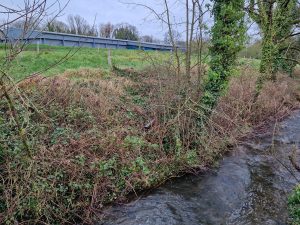
Caption: The land falls off towards the stream and road with the trees acting as a flow path break and buffer.